

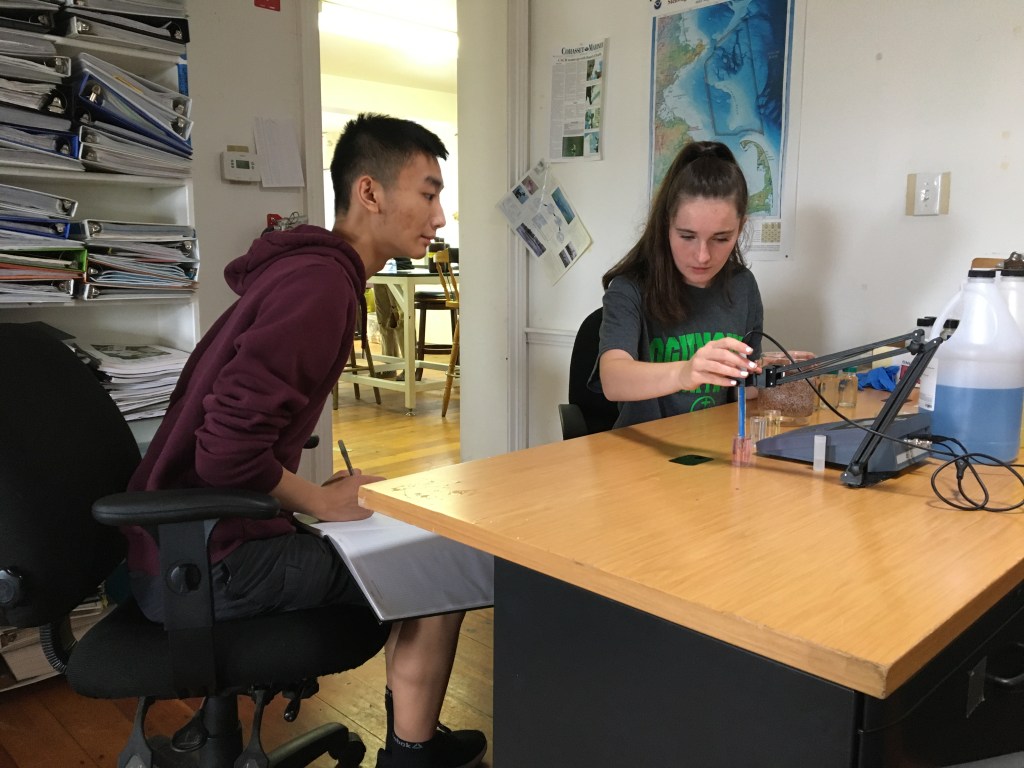
The Watershed Team tests water samples ranging from the fresh water of the upper reaches of the Gulf River watershed to the ocean water of Cohasset Harbor.
The team monitors dissolved oxygen, pH, temperature, salinity, chlorophyll-a, nitrates and enterococci bacteria. Students work with a variety of lab equipment, such as a Turner Designs fluorometer for nitrate analysis or detection of optical brighteners. Fluorometry is used in biochemistry for measuring the intensity of fluorescence and absorbance when light passes through a liquid (water sample). CSCR’s analyses helps us understand if there is too much bio-chem productivity, for example, a condition that causes algae blooms and a subsequent reduction of oxygen (and life) in an ecosystem.
For a look at the team’s 2023 Data, click here.




Description of Traditional Sites in the Gulf River:
The Watershed Team studies four different sites relating to the Gulf River. Three of the sites, Shockmans, Bleakies, and Musquashicut are located directly on the Gulf River, while the fourth site, Hunters Pond, is located on a freshwater source that feeds into the Gulf River. Shockmans is located closest to the mouth of the river, and as you continue farther upstream you first run into Bleakies, then later Musquashicut. The freshwater source the Hunters Pond site sits on feeds into the Gulf River farther upstream from Bleakies.
Description of Analytes:
Enterococci is the bacteria that the team measures at our three marine sites: Shockmans, Bleakies, and Musquashicut. Since Hunters Pond is a freshwater site, E. coli bacteria is measured instead. Bacteria are quantified using an IDEXX Quanti-Tray system and are measured in MPN/100mL. MPN/100mL stands for most probable number per 100 milliliters, or in simple terms this is the amount of bacteria in the water. For Enterococci (Shockmans, Bleakies, and Musquashicut), the cut-off where the water becomes unsafe to swim in is 104 MPN/100mL. For E. coli the cut-off is 235 MPN/100mL.
For public health details about bacteria monitoring, click here.